
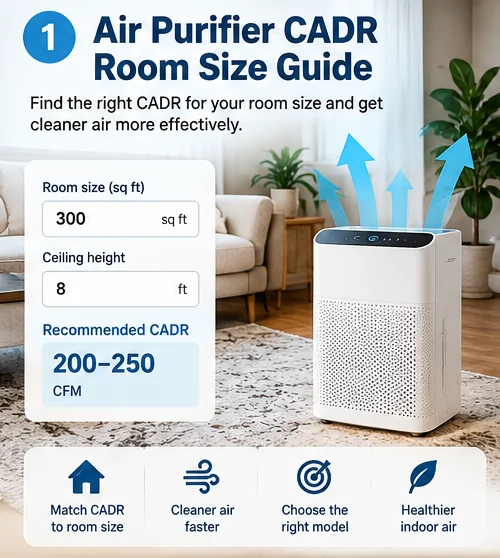
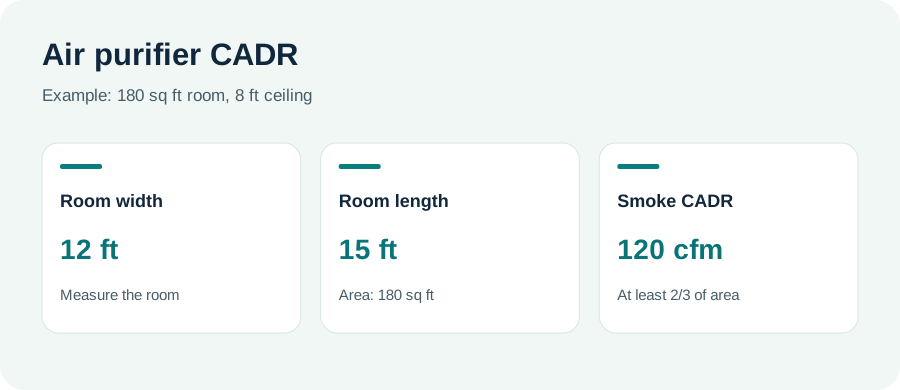
Quick answer: For an ordinary room with an 8-foot ceiling, Health Canada recommends selecting an air cleaner whose tobacco-smoke CADR in cubic feet per minute (cfm) is at least two-thirds of the room’s floor area in square feet. For a 12 × 15 ft room (180 sq ft), that means a smoke CADR of at least 120 cfm. A higher CADR gives extra filtering capacity, but room layout, noise and continuous use also matter. Health Canada.
What CADR actually measures
Clean air delivery rate (CADR) describes how quickly a portable air cleaner delivers air cleaned of certain airborne particles under a test. Labels commonly list different CADR values for smoke, dust and pollen. Higher numbers mean faster particle-cleaning capability for the tested contaminant; CADR is not a measure of how many watts the appliance consumes or how quietly it runs.
Use smoke CADR when fine particles are a priority, including many wildfire-smoke particles. Health Canada explains why the smoke measure is useful for small particles. A unit may advertise a huge area based on an unspecified turnover assumption, so compare the certified CADR value instead of the largest number printed on the box.
Calculate the room requirement in three steps
- Measure floor area. Room width × length in feet = square feet.
- Multiply by two-thirds. Minimum smoke CADR (cfm) ≈ floor area × 2 ÷ 3 for a typical 8-foot ceiling.
- Choose a machine rated at least that high at a fan speed you can actually tolerate. Check whether its stated CADR assumes maximum speed.
| Room dimensions | Floor area | Guideline minimum smoke CADR |
|---|---|---|
| 10 × 10 ft | 100 sq ft | about 67 cfm |
| 10 × 12 ft | 120 sq ft | 80 cfm |
| 12 × 15 ft | 180 sq ft | 120 cfm |
| 15 × 20 ft | 300 sq ft | 200 cfm |
| 20 × 20 ft | 400 sq ft | about 267 cfm |
These are calculated examples from Health Canada’s rule, not independently certified model ratings. NRCan also publishes a room-size/CADR reference table with approximate values; rounding conventions may differ. NRCan.
Worked example: a Canadian living room
Suppose your living room is 4 m × 5 m, or 20 m² (approximately 215 sq ft). Applying the area rule in square feet, the minimum smoke CADR is about 143 cfm. Do not multiply a metric room area directly by two-thirds and label the answer cfm; the rule is unit-specific.
If the ceiling is 10 ft rather than 8 ft, the room holds about 25% more air than the standard-height assumption. As a rough volume-adjusted screening estimate, 143 × 10 ÷ 8 ≈ 179 cfm. This adjustment is a useful practical estimate, not a Health Canada-certified formula; consult product guidance and consider higher capacity for high particle loads or connected spaces.
Why a HEPA label does not replace CADR
A high-efficiency particulate air (HEPA) filter can capture fine particles as air passes through it, but overall room cleaning also depends on airflow, filter installation and bypass leakage. Two devices with similar filter claims can perform differently if one moves much less air. Health Canada recommends considering both filter effectiveness and CADR.
For gases and odors, an activated carbon or other sorbent may help with certain chemicals, but there is no broadly accepted CADR-style rating for general gaseous pollutant removal. A particle filter cannot be assumed to solve every odor or chemical exposure. EPA.
What if the air purifier is too noisy on high?
Many devices publish their best CADR at a higher fan setting. If that is too loud to use during sleep, the actual particle reduction may be lower at the quieter setting. Check measured noise, replacement-filter costs and whether you can place the unit where airflow remains unobstructed.
Check ozone emissions, not just particle ratings
Some electronic air-cleaning technologies can produce ozone. Health Canada advises avoiding air cleaners that generate ozone and recommends checking certification information. Look for models certified by the California Air Resources Board (CARB) for ozone emissions. A CARB-listed device does not mean all air-cleaning performance claims are established. Health Canada · Health Canada on fine particles.
A practical comparison checklist
| Question | What to inspect |
|---|---|
| Is the unit sized correctly? | Certified smoke CADR relative to your room size |
| Does it handle fine particles? | Smoke CADR and reliable particle-filter performance |
| Is it affordable to own? | Replacement filter price, replacement frequency, power use |
| Will you actually run it? | Noise at intended speed, space for unobstructed airflow |
| Does it emit ozone? | Avoid intentional ozone generators; check recognized low-ozone testing |
| Are you trying to fix dampness? | An air purifier does not lower relative humidity or repair a leak |
Frequently asked questions
Is a 500-square-foot rating enough for a 500-square-foot room?
Only if the manufacturer’s claimed room-size basis delivers adequate particle removal for your goal. Verify the smoke CADR rather than relying on advertising square footage alone.
Will two smaller purifiers work instead of one big one?
They can improve distribution across a divided or awkward room if each has suitable capacity. CADR totals can be a rough planning tool, but actual air mixing, doorways and placement matter.
Does an air purifier remove CO2 or fix poor ventilation?
Typical particle filters do not meaningfully address accumulated indoor carbon dioxide. Source control and adequate ventilation remain important; open windows only when outdoor air quality permits.
Can I run it with windows open?
You can, but outdoor particle entry may overwhelm the benefit. During wildfire-smoke events, follow local public-health advice and avoid bringing polluted outdoor air indoors. Health Canada.
Bottom line: Compare smoke CADR, room size, noise and filter cost. Think of CADR as a measured cleaning-speed indicator, not a guarantee of healthy air in every situation.