
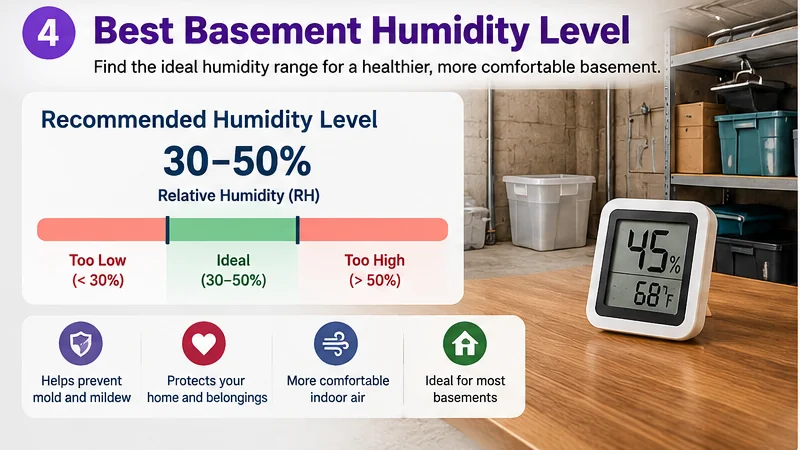
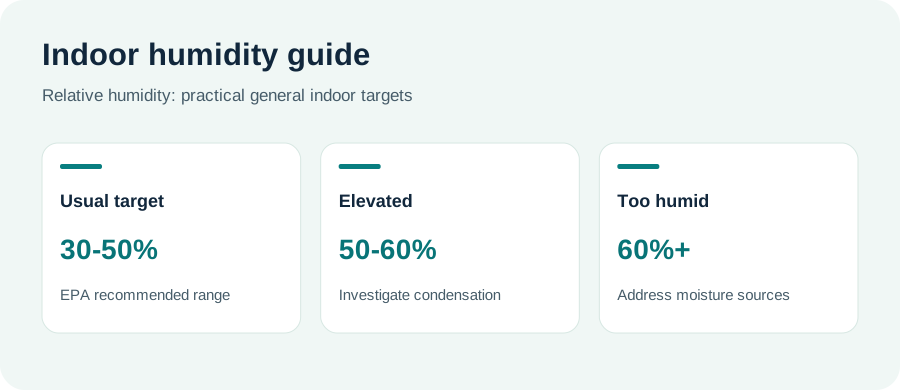
Quick answer: A practical indoor relative-humidity target is 30–50%, and it is generally important to keep humidity below 60% to limit the conditions that support mold. The US Environmental Protection Agency states both thresholds. A baseline of 60% or higher, persistent condensation or musty odors deserves investigation, especially in a basement. EPA.
What relative humidity tells you
Relative humidity (RH) is the amount of water vapor in air compared with how much that air could hold at its present temperature. It is not the same thing as an absolute quantity of water and changes when air temperature changes. An inexpensive hygrometer can help you monitor the space, though low-cost devices may vary in accuracy.
Humidity is only one clue. A wall can be wet behind furniture even if a hygrometer in the center of the room reads 45%. Condensation, stains, soft materials and recurring damp smells should trigger a moisture-source check.
Interpreting readings without panic
| Indoor RH | Practical interpretation |
|---|---|
| Below 30% | May feel excessively dry; check comfort and any condensation concerns before changing settings |
| 30–50% | Within the EPA’s ideal general indoor range |
| 50–59% | Above the ideal range; monitor more closely for condensation and rising trends |
| 60–69% | At or above the EPA’s recommended upper limit; investigate and control moisture |
| 70% or more | Substantial humidity; check leaks, infiltration, wet materials and equipment performance promptly |
These are decision-support bands, a general indoor-humidity guideline or a guarantee that mold will or will not occur at a particular number. Temperature, duration, wet surfaces and building materials also matter.
Why basement measurements can be misleading
Basements often have cooler surfaces than upper floors. Warm humid air entering a cool basement can condense on walls or pipes even when the overall RH appears only moderately elevated. Conversely, a dehumidifier might keep the center of the room near 45% while water continues to enter behind drywall or under flooring.
Place the hygrometer away from direct supply air, wet laundry, the dehumidifier exhaust and cold windows. Consider a second reading near the problem area. Check several times over days, especially after rain and during seasonal changes.
A three-day troubleshooting exercise
This is a practical monitoring suggestion, a practical monitoring approach:
- Record RH and temperature morning and evening for three days, using the same locations.
- Note weather, rainfall, basement windows being open, showers/laundry and the dehumidifier setting.
- Inspect gutters, foundation grading, pipes and visible condensate for water sources.
- If RH rises mainly during wet-weather events, examine drainage and seepage rather than treating the problem as only humid air.
- If RH stays high when a properly sized dehumidifier runs continuously, evaluate airflow, drainage, operating temperature and possible continuing water entry.
Summer versus winter
In humid summers, outside air may carry more moisture than basement air; opening a basement window can worsen dampness. Run appropriate ventilation when outdoor conditions are favorable, or use a dehumidifier when needed.
In a cold Canadian or northern US winter, very cold windows and foundation surfaces can develop condensation at humidity levels that were comfortable in summer. ENERGY STAR notes that 30–40% RH is often appropriate during colder heating seasons to help prevent window condensation. Use observed surface conditions rather than forcing a single year-round setting. ENERGY STAR.
What a dehumidifier can and cannot solve
A dehumidifier removes moisture from the air. It can help maintain a chosen RH when moisture load is manageable. It cannot stop a plumbing leak, prevent rainwater entering through a foundation crack, or clean mold already present.
The EPA emphasizes moisture control and prompt drying after leaks. If water damage, significant growth or contaminated materials are present, follow public-health or qualified remediation guidance rather than simply lowering the humidity dial. EPA mold guidance.
Questions homeowners ask
Is 55% basement humidity bad?
It is above the EPA’s ideal 30–50% range but below its general 60% upper limit. Check for condensation, wet materials and trends; the number alone does not prove a mold problem.
Is 40% too dry in a basement?
Usually not by general EPA guidelines, provided occupants are comfortable and there are no special circumstances. Avoid unnecessarily drying a space simply to reach the lowest possible number.
Should the dehumidifier run 24/7?
Not always. A humidistat-controlled model can cycle as required. If it never reaches the target, investigate sizing, settings, outside air entry and water sources.
Can I trust one hygrometer?
Use it to track trends, but account for placement and accuracy. Two gauges in different zones can reveal uneven humidity that a single reading hides.
Bottom line: Use 30–50% RH as a reasonable general goal, stay alert above 60%, and give more weight to actual dampness, condensation and water intrusion than to one sensor reading.