
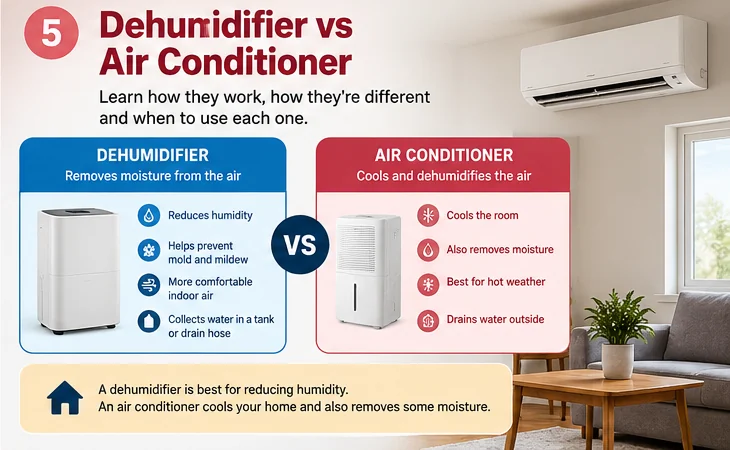
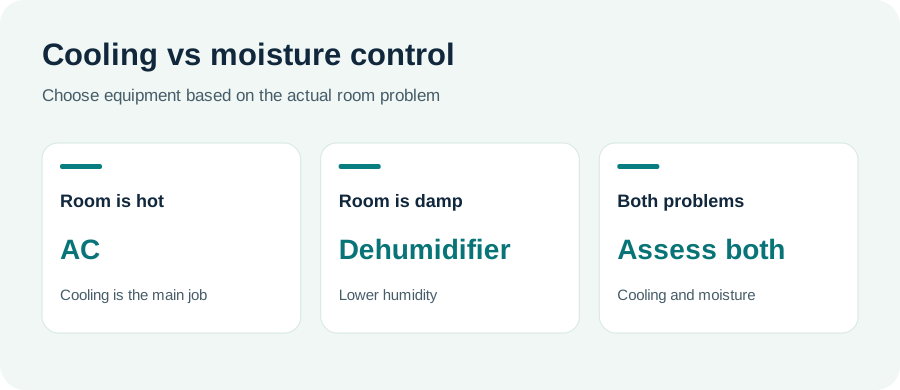
Quick answer: Choose an air conditioner when you need to cool a hot room and expect some moisture removal as a benefit. Choose a dehumidifier when the main problem is high humidity in a room that doesn’t need cooling, such as a cool basement. Both may condense water from indoor air, but their controls, heat effects and useful operating conditions differ. ENERGY STAR dehumidifier guidance.
Why the two appliances are not interchangeable
A typical compressor dehumidifier cools an internal coil so moisture condenses from air, collects that water, and then reheats the air before releasing it into the same room. The space may feel slightly warmer while it becomes drier. The primary job is humidity control.
A conventional room air conditioner removes heat from the indoor space and rejects it outdoors (or through an exhaust system for portable models). As indoor air passes over a cold coil, it can also remove moisture, but its thermostat is generally trying to achieve a temperature target. If the room already feels cool, the AC may not run long enough to remove much water.
Compare by situation
| Question | Dehumidifier | Air conditioner |
|---|---|---|
| Main purpose | Lower RH | Lower indoor temperature |
| Removes water from air? | Yes | Usually while cooling |
| Typical heat effect indoors | Can warm the room | Cools the space when correctly installed |
| Works well in a cool, humid basement? | Often, if rated for operating temperature | Usually a poor match if cooling isn’t needed |
| Can you set a humidity target? | Typically yes, with a humidistat | Depends on model and controls |
| Needs water handling? | Bucket, hose or pump | Condensate drain, depending on system |
| Repairs leaks or mold growth? | No | No |
Neither technology can replace water-intrusion repairs or appropriate ventilation.
Example 1: Basement at 19°C (66°F) and 68% RH
Cooling the basement further may make it uncomfortable and can increase the likelihood of condensation on cold surfaces. A suitably rated dehumidifier is usually the more practical choice, together with an inspection for leaks or damp building materials. Check whether the unit supports the room’s temperature range; some units frost up in cooler conditions.
Example 2: Upstairs bedroom at 28°C (82°F) and 60% RH
You need cooling. A properly sized air conditioner can address heat and remove some water as it runs. ENERGY STAR warns that an oversized room AC can cool a room before removing enough humidity, producing a cold, clammy feeling. Bigger does not always mean better. ENERGY STAR room AC guidance.
Example 3: Home already at a comfortable temperature, RH stays above 60%
A supplemental dehumidifier may control RH without forcing the room temperature lower. In some homes, cooling and moisture control need to be assessed separately. In humid weather, a room can reach a comfortable temperature while humidity stays high, because the AC stops running once the thermostat is satisfied. A dehumidifier with its own humidistat handles the moisture separately.
Which costs less to run?
There is no honest universal winner. A portable dehumidifier and a room AC have different loads and jobs, so comparing their nameplate watts alone is misleading. The equipment that runs for fewer hours under your conditions might use less electricity, but the final cost depends on climate, setpoints, efficiency and the moisture or cooling load.
To compare electricity cost for either appliance, use:
Electricity cost = (watts ÷ 1,000) × hours used × local price per kWh.
: A 350-watt appliance running eight hours uses 2.8 kWh. At an illustrative rate of 15¢ per kWh (check your own electricity bill) per kWh, that costs $0.42 in the same currency. Insert the current electricity price on your own bill; this is not a stated Quebec or US utility rate. That arithmetic does not show that it removes the same moisture as a different appliance.
For dehumidifiers, look at integrated energy factor (litres removed per kWh). For air conditioners, compare the relevant cooling-efficiency rating, properly sized capacity and expected usage. Avoid inferring moisture removal from cooling BTUs alone.
If the room still smells damp
Start by fixing water entry, plumbing leaks, blocked condensate drains, poor exterior drainage and wet materials. A dehumidifier can control water vapor, but it does not stop active seepage or safely remove mold. The EPA emphasizes eliminating the moisture source. EPA.
Common questions
Can I run both at once?
Yes, if there is a real need for both cooling and humidity control. The dehumidifier releases heat into the room, which can increase cooling demand; whether the combination is sensible depends on conditions and equipment.
Is ‘dry mode’ on an AC the same as a dedicated dehumidifier?
Not necessarily. Dry mode changes fan/compressor behavior, but its performance and available RH controls vary by manufacturer. Consult the specific manual.
Will running my AC at a lower temperature always dry the room faster?
No. Longer runtime can remove moisture, but overcooling wastes energy and can cause discomfort. Proper sizing and humidity control matter more than forcing an unnecessarily low thermostat setting.
Which one should I buy for a basement?
If cooling is unnecessary and humidity is consistently high, begin with moisture-source checks and a properly sized dehumidifier. If the basement is hot, evaluate cooling and humidity requirements separately.
Bottom line: AC is designed primarily to cool; a dehumidifier is designed primarily to dry. Diagnose which problem you’re solving before comparing prices.