
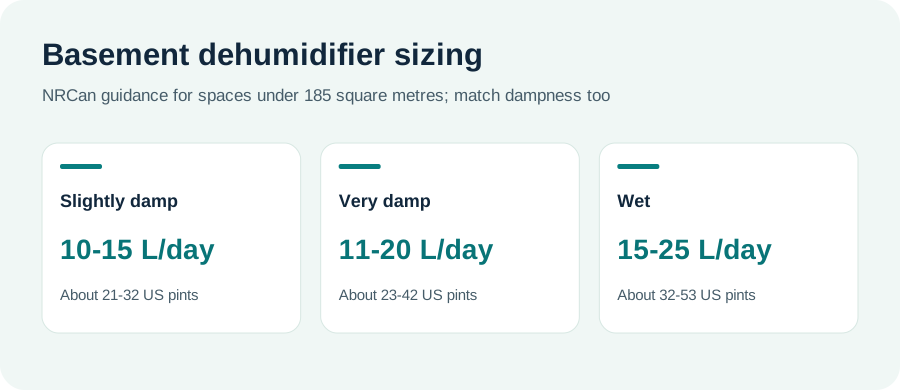
Quick answer: For a typical basement smaller than 185 m² (about 2,000 sq ft), Natural Resources Canada suggests roughly 10–15 L/day for slightly/moderately damp rooms, 11–20 L/day for very damp rooms and 15–25 L/day for wet rooms. Capacity must reflect both floor area and dampness, not floor area alone. Compare the rating standard on any US-pint/day label and repair water intrusion before treating a wet basement with an appliance. Source: Natural Resources Canada.
Start with the problem, not the advertised pint number
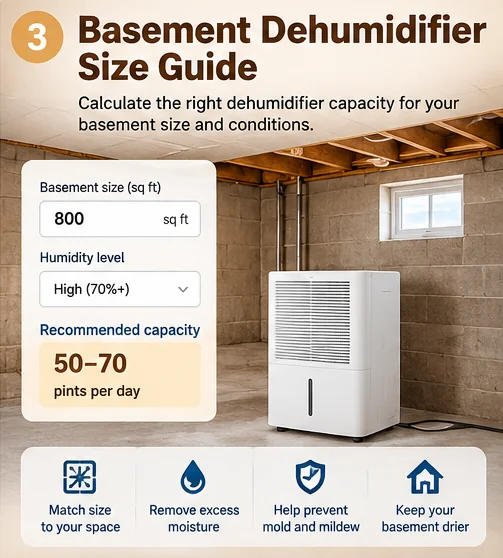
A dehumidifier’s rated capacity describes how much water it can remove from air in 24 hours under specified test conditions. It is not the tank size, and the machine will not necessarily collect that amount in your basement every day. Temperature, actual humidity, airflow, wet materials, and cycling all change real-world collection.
Measure the connected area that you need to dry. A 20 × 25 ft finished room is 500 sq ft. If a door stays open into a second humid room, consider the connected space rather than only the appliance’s corner. A very wet basement can require more removal than a much larger basement with mild humidity.
Recommended capacity: Canadian litres per day first
The NRCan table below applies to rooms under 185 m² (about 2,000 sq ft). Larger rooms have recommendations above the ranges shown. These are approximate buying categories, not promises about daily collection in your basement.
| Dampness before dehumidifying | Signs and RH described by NRCan | NRCan capacity, L/day | Approx. US liquid pints/day by volume |
|---|---|---|---|
| Slightly to moderately damp | Musty, about 50–75% RH | 10–15 | 21–32 |
| Very damp | Consistently damp, about 75–90% RH | 11–20 | 23–42 |
| Wet | Sweating walls/floors or high moisture load, about 90–100% RH | 15–25 | 32–53 |
The pint column is a mathematical conversion of litres, not a historical US product-rating equivalence. ENERGY STAR publishes its own broadly comparable US-oriented sizing recommendations; refer to each source’s intended market and test-standard context. NRCan capacity table · ENERGY STAR buying guide.
For spaces over 185 m², NRCan recommends more than 15, 20 or 25 L/day, respectively, according to dampness. Multiple zones, doors and active leaks may require a more specialized solution.
Three realistic basement examples
Example A: 500 sq ft, 62% RH, occasional musty smell. This falls within the slightly/moderately damp category. The NRCan 10–15 L/day category is a starting point, not a final equipment specification. Use a hygrometer to see whether it maintains the chosen humidity after doors and windows stay closed.
Example B: 1,000 sq ft, 82% RH, repeated damp patches. This resembles a very damp space. The NRCan 11–20 L/day category is more relevant, but check for foundation seepage, plumbing leaks or poor drainage. Removing water vapor does not fix liquid-water entry.
Example C: 1,800 sq ft with water pooling after heavy rain. Fix drainage or infiltration and dry affected materials promptly. Buying the largest portable machine first is not a solution to the underlying water problem. For major or recurring water damage, consider qualified building remediation.
Canada and US units: pints are not litres
A US liquid pint is approximately 0.473 litres, so a current 30-US-pint/day rating converts to about 14.2 L/day. Do not compare a 30 L/day Canadian specification with 30 US pints/day as though they were equal; the litre figure represents more than twice the water volume.
There is a second trap with older US capacity ratings. The US Department of Energy’s updated dehumidifier standards took effect in June 2019. Portable units are tested at 65°F instead of 80°F, and differently rated models began appearing in early 2020. ENERGY STAR’s approximate portable-unit comparison is:
| Older rating (through 2019) | Approximate newer rating (2020) |
|---|---|
| 30 US pints/day | 20 US pints/day |
| 50 US pints/day | 30 US pints/day |
| 70 US pints/day | 40–45 US pints/day |
This is not a universal conversion formula: actual differences vary by product. The often-repeated claim that an old 70-pint model universally equals a new 50-pint unit does not match ENERGY STAR’s published approximate table. Compare current ratings and model-specific specifications. ENERGY STAR testing and capacity.
Check these before buying
- Basement temperature: In cooler basements, frost may build on the coils of some refrigerant models; ENERGY STAR says buyers should consider cold-temperature suitability when the room commonly falls below 65°F (18°C).
- Drainage: A bucket requires emptying and may shut off when full. A gravity hose needs a suitable lower drain; a condensate pump may be needed for an uphill route. Keep hoses clear of electrical connections.
- Operating noise and placement: Leave the airflow clearance specified by the manufacturer. Closed doors and windows generally improve performance.
- Efficiency: Compare integrated energy factor (IEF, L/kWh) for similar units. A higher IEF means more water removed per unit of electricity under the test procedure.
- Humidity controls: A built-in humidistat helps cycle the appliance; an independent hygrometer is useful to check the reading.
What humidity should you aim for?
For humidity targets, measuring methods and winter-condensation considerations, see our companion basement humidity guide. Water intrusion needs repair independently of any RH setpoint.
Frequently asked questions
Is a 50-pint dehumidifier too big for a 500-square-foot basement?
Not necessarily, but it may be unnecessary for mild dampness. A larger unit may reach the humidity target faster and cycle off; purchase cost, energy performance, noise and drainage still matter. Evaluate the actual moisture load.
Will a dehumidifier eliminate mold already growing on a wall?
No. Moisture control helps reduce conditions that support mold, but existing mold and the water source must be addressed appropriately. EPA.
Does the full rated capacity go into the bucket each day?
No. A rating is measured under standardized conditions; real collection changes with temperature, humidity and runtime.
Should I buy two smaller units instead?
For separated rooms, two strategically placed units may control humidity more evenly than one behind a closed door. Measure each zone and compare their total power, noise and maintenance requirements.
Bottom line: Measure the connected space, classify dampness, choose a current-standard capacity, and fix water intrusion first. A dehumidifier controls moisture in air; it does not waterproof a basement.