
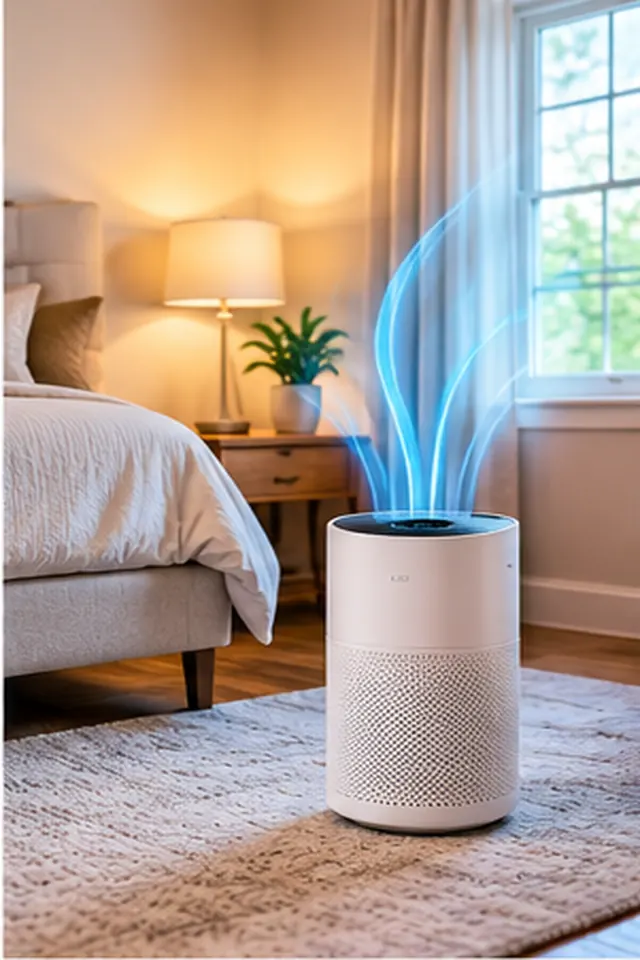
Air changes per hour (ACH) describes how many room-volumes of air move or are supplied in an hour. When discussing a portable particle-filtering device, the relevant shortcut is equivalent clean-air changes from its particle CADR. That is different from outdoor-air ventilation or a measured HVAC air-change rate.
The arithmetic in US units
Equivalent particle-cleaning ACH is smoke CADR (cubic feet per minute) multiplied by 60, divided by room volume (cubic feet). A 200-cfm smoke-CADR purifier in a 20 × 15 × 8-foot room has 2,400 cubic feet of volume. The simplified result is 200 × 60 ÷ 2,400 = 5 equivalent clean-air changes per hour.
What ACH does not tell you
This result assumes approximately uniform mixing and a sustained rated CADR. Actual effectiveness depends on airflow pathways, fan speed, doors, particulate sources, and position. It does not show oxygen supply, fresh outdoor-air ventilation, carbon dioxide removal or gas/VOC filtration.
How ACH relates to the EPA room-size chart
EPA’s approximately 0.65 cfm per square foot sizing reference at eight-foot ceilings corresponds mathematically to about 4.9 equivalent clean-air changes per hour. This is a relationship in the reference arithmetic, not a guarantee that any real room receives uniform cleaning.
How to interpret an example
If a purifier’s advertised CADR was tested at maximum speed, entering that number estimates performance at that setting. On a quieter setting the rate can be lower, so the high-speed ACH should not automatically be treated as a round-the-clock value.
Calculate equivalent clean-air changes
Equivalent clean-air changes per hour (eACH) from a portable purifier can be estimated using:
eACH = smoke CADR (cfm) × 60 ÷ room volume (cubic feet).
Consider a 20 × 15 ft room with an eight-foot ceiling. Its volume is 2,400 cubic feet. With a purifier delivering 200 cfm of smoke CADR:
200 × 60 ÷ 2,400 = 5 equivalent clean-air changes per hour.
| Smoke CADR | eACH for this example room |
|---|---|
| 100 cfm | 2.5 |
| 150 cfm | 3.75 |
| 200 cfm | 5.0 |
| 250 cfm | 6.25 |
This is a simplified particle-removal equivalence that assumes reasonably mixed air. It is not five fresh outdoor-air changes per hour. A portable particle purifier does not supply oxygen or provide reliable carbon dioxide removal.
For two purifiers in the same open volume, their rated smoke CADR values can be added as a planning estimate, although placement, mixing, obstruction and fan settings affect real performance.
This calculator is helpful for understanding filtration capacity; it is not a ventilation-code compliance tool.
Why some room-size charts use 0.65 instead of two-thirds
Some room-size charts use approximately 0.65 cfm of smoke CADR per square foot for an eight-foot ceiling. Wisnaro’s room-sizing calculators use the slightly more conservative two-thirds guideline, which corresponds to approximately five equivalent clean-air changes per hour under a simplified well-mixed-room assumption.
For a 300-square-foot room with an eight-foot ceiling, that means 200 cfm using the two-thirds rule, compared with 195 cfm at 0.65. These are planning comparisons, not measured room performance.
Related Wisnaro guides
Frequently asked questions
Does 5 ACH mean my room gets outdoor fresh air five times per hour?
No. A recirculating purifier cleans particles from existing room air; it does not necessarily bring outdoor air indoors.
Can I enter m³/h instead of cfm?
Use the unit selector in the calculator. The equivalent result is unit-independent when conversions are applied correctly.