
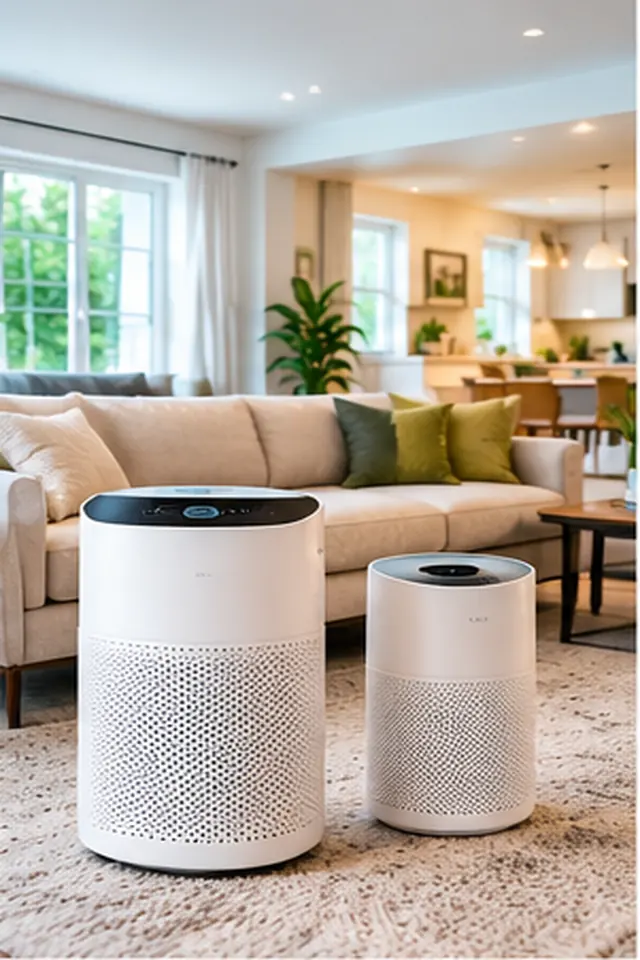
A single properly sized air purifier is often simpler than several small units. But an L-shaped living area, connected rooms or a purifier with a low smoke CADR may call for more than one. The useful number is rated clean-air delivery, not a large square-footage claim that does not say how it was measured.
Start with the room, not the whole house
Measure the space where you actually want particle filtration. An open kitchen-living room may be treated as a shared volume, but bedrooms behind closed doors generally need their own coverage. Portable cleaners serve individual rooms; a machine in a hallway is not a substitute for measuring conditions in each closed room.
Use smoke CADR as the comparison point
For an eight-foot ceiling, Wisnaro uses a minimum smoke CADR of two-thirds of the room area in square feet, consistent with US EPA wildfire guidance and Health Canada guidance. The calculator uses the EPA’s published sizing relationship and adjusts upward proportionally for taller ceilings as a planning estimate. The higher ceiling adjustment is not a certified manufacturer rating.
Example: two smaller machines
For a 450-square-foot room with an eight-foot ceiling, the minimum planning estimate is 300 cfm of smoke CADR. If one candidate model offers 150 cfm at its rated setting, two units provide 300 cfm in simple arithmetic. That does not guarantee uniform mixing, and quiet-speed CADR may be lower than the rated high-speed value.
Location and noise matter
Keep air intakes and outlets clear of curtains, walls and furniture according to manufacturer instructions. A quieter device that occupants will actually run may perform better in practice than a powerful cleaner that stays switched off. Check the replacement-filter cost and avoid ozone-generating devices.
Worked scenarios: one purifier or several?
EPA’s wildfire guidance recommends smoke CADR of at least two-thirds of a room’s floor area in square feet for a typical eight-foot ceiling. Our calculator uses that recommendation, with an approximate proportional adjustment for taller ceilings.
| Room | Illustrative smoke CADR target |
|---|---|
| 150 sq ft, 8-ft ceiling | 100 cfm |
| 300 sq ft, 8-ft ceiling | 200 cfm |
| 450 sq ft, 8-ft ceiling | 300 cfm |
| 300 sq ft, 10-ft ceiling | 250 cfm, approximate |
For a 450-square-foot open room, two units each rated at 150 smoke CADR would total 300 cfm on paper. The arithmetic doesn’t guarantee even cleaning throughout the space.
For two separate bedrooms with closed doors, plan for room-specific filtration rather than assuming a single machine in the hallway will serve both.
When comparing devices, use smoke CADR at the fan setting you will actually run. A machine with a strong maximum-speed rating may deliver less filtration at its quieter overnight setting.
Source: EPA wildfire indoor air filtration.
Related Wisnaro guides
Frequently asked questions
Can I use one purifier for three bedrooms?
Not reliably when doors are closed. Consider each occupied closed room separately.
Is a HEPA claim enough to select the number?
No. Compare smoke CADR and operating conditions, not filter marketing alone.