
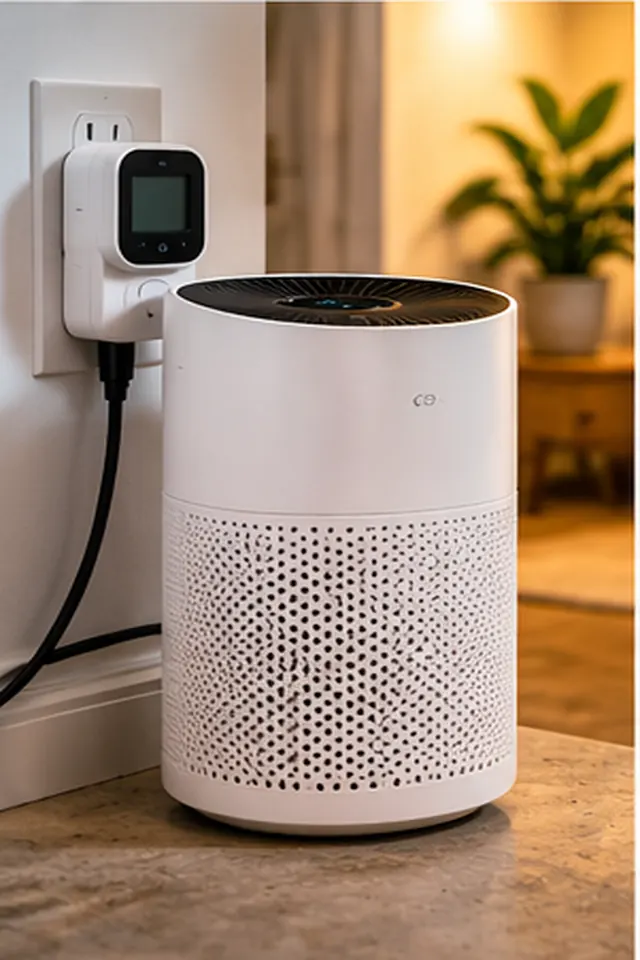
An air purifier might run for long hours, so understanding its wattage matters. The cost depends on how much power it actually uses at your preferred fan setting, how long it runs, and your electricity price. Use the machine’s rated running watts or a plug-in power meter rather than guessing from its room-size marketing.
Compute the energy, not the label size
A 45-watt cleaner running 24 hours uses 1.08 kWh each day. At an assumed $0.16 per kWh, that costs about $0.17 a day or $5.18 over 30 days. A different machine may draw more power on maximum fan speed and less in sleep mode. Our calculator uses your measured or label wattage and local rate.
Why fan speed changes both cost and cleaning
ENERGY STAR and EPA explain that higher fan settings generally clean more particles per unit of time. Turning a purifier down to save energy can reduce CADR. Choose a machine that provides useful clean-air delivery at a noise level you can tolerate, then compare operating cost at that setting.
Electricity is not the whole ownership cost
Replacement filters, prefilters and possible filter changes during wildfire-smoke episodes may exceed the electricity bill. Check filter availability and price before buying. A filter designed to capture particles does not guarantee removal of all gases or odors.
Use local currency correctly
Enter cents per kilowatt-hour in USD, CAD, or another local currency. The numerical result will be in that same currency; the calculator is not a live electricity-price lookup or exchange-rate converter.
How fan speed changes the calculation
An air purifier may be used much longer than a dehumidifier. For example, a model drawing 45 watts continuously consumes:
45 ÷ 1,000 × 24 = 1.08 kWh per day, or 32.4 kWh over 30 days.
At an illustrative rate of US$0.18/kWh, that is approximately US$5.83 for 30 days in energy charges. The example is arithmetic, not a measurement of a particular model.
| Operating pattern | 30-day electricity at 45 W |
|---|---|
| 8 hours/day | 10.8 kWh |
| 12 hours/day | 16.2 kWh |
| 24 hours/day | 32.4 kWh |
A quieter speed may use less electricity, but can also provide less clean-air delivery. Do not select an undersized purifier solely to save a small amount of power.
Compare operating electricity cost with the replacement filter’s price and lifespan. A low-power machine with expensive proprietary filters may cost more to maintain than expected.
The calculator’s output is expressed in the currency associated with the electricity rate entered. It does not retrieve a live utility tariff.
Related Wisnaro guides
Frequently asked questions
Is 24/7 operation always necessary?
Operating duration depends on air conditions and your goals. EPA notes that longer run times generally increase particle removal.
Does a bigger room rating mean higher electricity consumption?
Not necessarily. Compare actual watts, CADR and efficient operation for the specific model.