
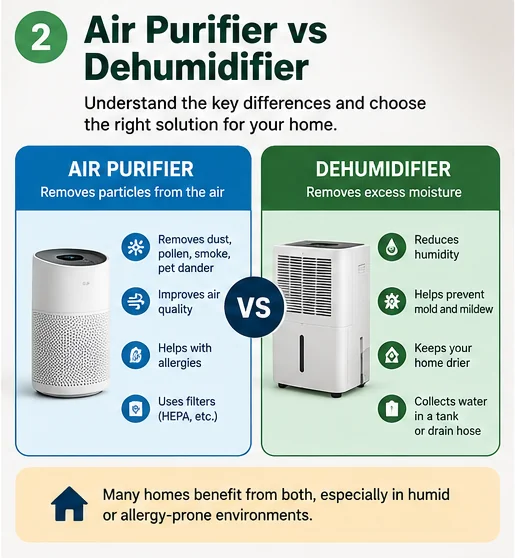
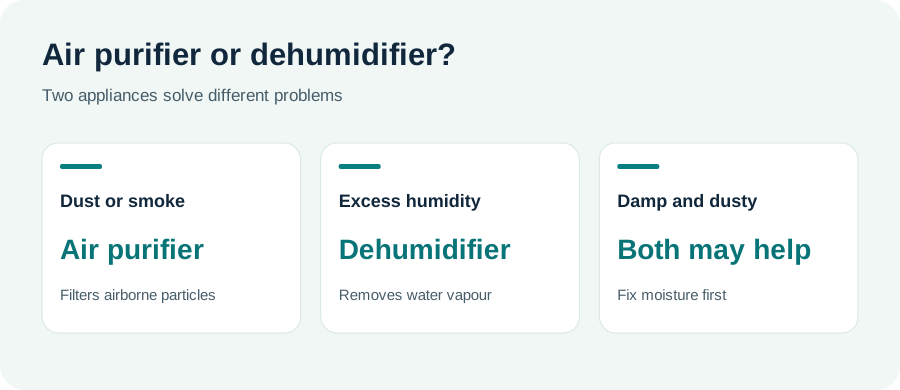
Quick answer: An air purifier reduces certain airborne particles, such as smoke, pollen and fine dust, by filtering circulating air. A dehumidifier removes water vapor, lowering relative humidity. One does not replace the other. If the room is damp, fix the moisture source and consider a dehumidifier; if particulate pollution is your main problem, consider a correctly sized air cleaner. EPA air-cleaner guide.
What each appliance actually changes
A portable air purifier draws air through a filter or other treatment system. Its particle-cleaning capability is commonly described using clean air delivery rate (CADR). A HEPA-based cleaner can help capture fine particles while running, but it does not remove moisture from the room.
A dehumidifier draws moist air across a cold coil so some water vapor condenses and is collected. Its capacity is commonly expressed in litres/day or US pints/day. Its job is not to capture airborne smoke particles or substitute for ventilation.
| Problem | Air purifier | Dehumidifier | Critical additional action |
|---|---|---|---|
| Dust or airborne pollen | Often helpful with appropriate filtration | Not designed for it | Cleaning, source reduction |
| Fine smoke particles | Can reduce indoor particles if sized and used appropriately | Not designed for it | Follow outdoor air-quality guidance; reduce entry |
| Humidity regularly over 60% | Does not lower RH | Can lower RH | Identify moisture source |
| Condensation on basement walls | Cannot stop condensation | May help if humidity-driven | Check leaks, cold surfaces and insulation |
| Existing mold on drywall | May capture some airborne particles | Can help avoid excessive RH | Fix moisture and address contamination |
| Strong chemical odors/gases | Some carbon media may help; performance varies | Not generally effective | Source removal and safe ventilation |
| Musty odor caused by seepage | Cannot repair cause | Cannot repair cause | Repair the leak or drainage issue |
The EPA explicitly states that air cleaners do not solve mold and moisture problems; filtration may reduce some airborne mold-derived particles but does not eliminate the conditions that let mold grow. EPA.
Three questions to decide what to buy
- Is there persistent dampness or condensation? Fix water entry first. Use a hygrometer and consult our basement humidity guide to interpret readings. A dehumidifier can help control airborne moisture but cannot repair a leak.
- Are particles the main concern? For pollen, fine dust or smoke, compare an air purifier’s smoke CADR at a usable fan speed. See the room-size and CADR guide for the sizing calculation instead of treating marketing room-area claims as comparable.
- Are materials already wet or contaminated? Stop the source of water and assess drying or remediation needs. Neither appliance removes waterlogged materials or fixes existing mold growth.
Example situations
Scenario A: Dry bedroom, seasonal pollen. RH is 42%, but airborne pollen is a concern. An appropriately sized particle-filtering air purifier is more relevant than a dehumidifier. Keep surfaces clean and manage exposure sources.
Scenario B: Basement at 74% RH with window condensation. The priority is moisture diagnostics and, if appropriate, a dehumidifier. An air purifier might reduce some particles but will not bring RH down.
Scenario C: Basement at 75% RH plus nearby wildfire smoke. There may be two separate problems: humidity and airborne particles. Moisture-source repairs or a dehumidifier can address the first, while a smoke-CADR-rated purifier and official air-quality guidance can address the second. Keep ventilation decisions aligned with outdoor conditions.
What about odors?
Odors have different sources. Musty smell may point to ongoing dampness, mold or wet materials. Some chemical odors are gases, which typical particle-only HEPA filters are not designed to capture. Ads claiming to remove every odor should be treated cautiously. Health Canada notes that gas-removal filters do not have a widely adopted rating system comparable with particle CADR. Health Canada.
Can both appliances run together?
Yes. There is no inherent conflict if both are installed and operated safely, but consider electrical loading, noise, placement and whether each addresses a distinct need. A dehumidifier may warm the room slightly. Follow each manufacturer’s electrical and drainage instructions.
Frequently asked questions
Does a dehumidifier clean the air?
It can reduce excess humidity, which can discourage moisture-related problems, but it does not replace a particle air cleaner. It should not be marketed as a way to filter smoke.
Will a HEPA purifier remove moisture?
No. Particle filtration and water-vapor removal are different physical processes.
Which is better for mold?
Moisture remediation is the priority. A dehumidifier can help control RH after leaks are resolved. A purifier may remove some airborne mold particles, but neither removes existing growth or fixes the water source. EPA.
Is it worth buying an air purifier for a basement that is already dry?
Only if there is a separate particle-pollution concern and an appropriately sized cleaner would be useful. Purchasing one only to change a humidity reading makes no sense.
Bottom line: Particles → air purifier. Humidity → dehumidifier. Leaks or mold growth → address the source first. Some homes need both appliances; many need only one or neither.