
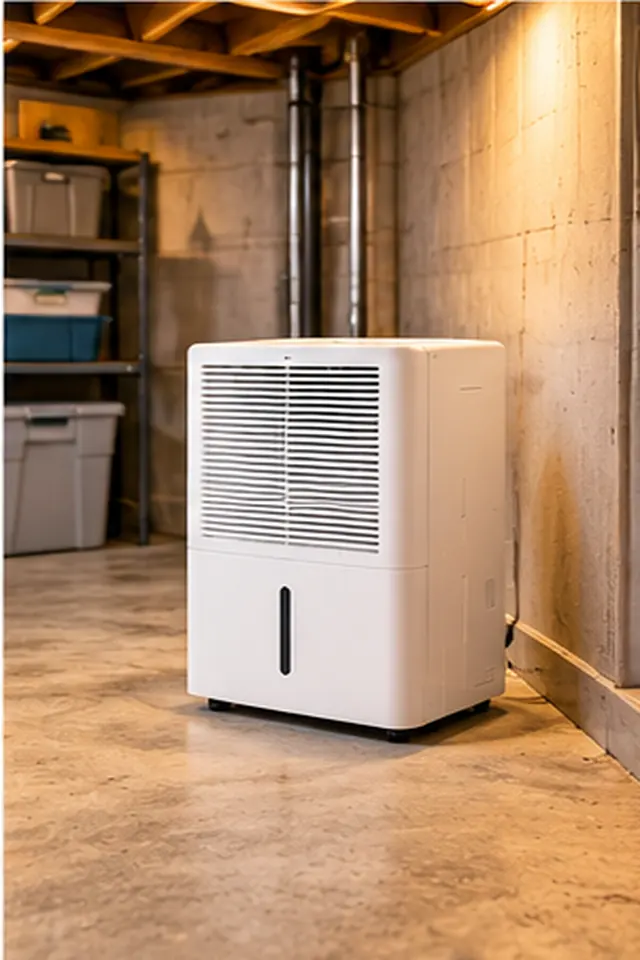
A dehumidifier works by pulling moist room air through its coils and releasing drier air. Placement influences how freely air moves through the machine and how safely collected water is drained. The best location is rarely defined by a universal distance from a wall: manufacturers specify minimum clearances for their own models.
Keep the intake and outlet unobstructed
Read the exact manual and preserve the required clearance around air intakes and exhaust openings. Do not block the unit with laundry, furniture, curtains or storage boxes. Position it on a stable, level floor where it cannot tip or become submerged.
Choose drainage before convenience
A floor drain or appropriately installed condensate pump can eliminate the need to carry a heavy bucket. Check the hose slope, approved fittings, overflow protection and manufacturer directions. Do not run drainage to an area where freezing, flooding or backflow could occur.
Consider room separation and temperature
An enclosed utility room can behave differently from a large open basement, so doors and circulation matter. Some portable units lose water-removal performance in cold conditions or require defrost cycles. Confirm the operating-temperature range rather than guessing based on floor area alone.
A practical example
For a moderately damp basement with storage shelving, choose a level surface that preserves the specified clearance and provides a safe drain path. Log humidity at more than one location after setup. If one corner remains wet after improving circulation, examine whether the wall or floor is leaking.
Placement decisions that change performance
Start with the manufacturer’s clearance instructions, not a universal distance from walls. Units differ in where they draw in and discharge air.
| Location question | Recommended check |
|---|---|
| Is the intake behind furniture? | Clear the required airflow path |
| Is the machine on an uneven surface? | Use a stable location allowed by the manufacturer |
| Will it drain continuously? | Check hose slope, drain location and overflow risk |
| Is the basement very cold? | Verify rated operating temperature |
| Is there standing water nearby? | Resolve water and electrical hazards first |
Example: choosing between two basement locations
One corner is next to a blocked return-air grille and has little clearance around the dehumidifier. Another is level, accessible for cleaning and near a suitable drain. If the manufacturer’s instructions permit the second position, it is generally the more practical option.
Do not assume placing the machine directly against the dampest wall will solve a moisture intrusion problem. Portable equipment treats air moisture; it does not repair foundation drainage.
For a basement divided into closed rooms, measure humidity in more than one location before concluding that a single appliance controls the entire area.
If continuous drainage requires a pump, use equipment and routing appropriate to the application and protect against overflow.
Related Wisnaro guides
Frequently asked questions
Is the center of the room always best?
No. Clearance, drainage, safety and circulation matter more than a rigid center-placement rule.
Can I put a dehumidifier directly against a wall?
Only if the manufacturer explicitly permits that clearance.