
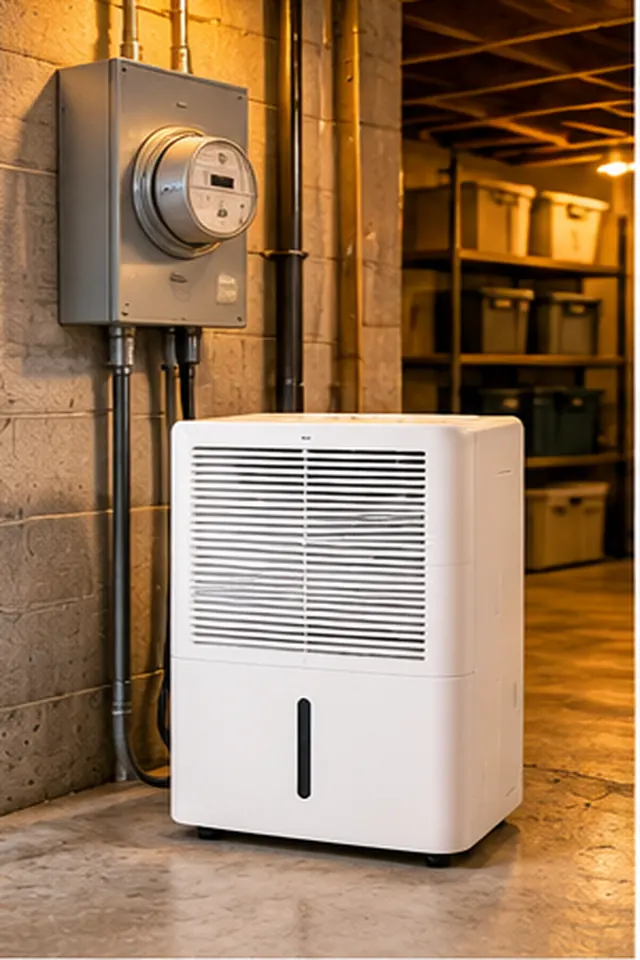
A dehumidifier’s running cost depends less on the size printed on the box than on how many watts it draws and how long the compressor runs. The most useful estimate starts with the unit’s own label or a watt-meter reading. This guide explains the arithmetic, the assumptions, and the trade-off between higher efficiency and water-removal capacity.
The calculation that matters
Electricity is billed in kilowatt-hours (kWh). Multiply watts by operating hours, then divide by 1,000. Multiply by the electricity rate. For example, a 350-watt machine running eight hours per day uses 2.8 kWh daily. At $0.16 per kWh, that is approximately $0.45 per day or $13.44 over a 30-day month. These are assumed values, not a typical US utility rate or a product specification.
Why real bills can differ
A compressor-controlled unit usually cycles as the room approaches its humidity set point. The fan may still run, and electrical consumption differs by operating mode. A hot, wet basement can require considerably more runtime than a dry bedroom. An energy monitor can replace guessed hours with measured kWh; that is the best way to improve this estimate.
How to compare two machines fairly
Compare current-capacity ratings, energy efficiency and the volume of water removed at comparable test conditions. ENERGY STAR documents that dehumidifier capacity-testing methods changed, so an older 70-pint label does not directly match a current 70-pint label. If a cheaper machine runs nearly continuously, it may not save electricity in the conditions you actually have.
Practical ways to lower costs
Fix water entry and plumbing leaks first. Seal obvious unwanted infiltration where appropriate, keep doors and windows controlled, direct condensate to a safe drain and avoid setting an unnecessarily low humidity target. Do not turn off essential humidity control simply to save electricity when materials remain wet.
Worked example: a dehumidifier that cycles
Suppose a portable dehumidifier draws 400 watts while actively operating, but its compressor does not run continuously. If it effectively operates at that draw for six hours per day, the simplified consumption is:
400 ÷ 1,000 × 6 = 2.4 kWh per day.
Over 30 days, that becomes 72 kWh. At an illustrative electricity price of US$0.18/kWh, the estimated energy charge is US$12.96. This example excludes other fixed charges and differences between standby, fan and compressor operation.
| Average active hours/day | 30-day use at 400 W |
|---|---|
| 4 | 48 kWh |
| 6 | 72 kWh |
| 8 | 96 kWh |
| 12 | 144 kWh |
Use a suitable plug-in electricity meter to observe real consumption if your equipment and outlet permit it. Do not assume that the label wattage is the measured average. Use your local utility tariff, including relevant time-of-use prices, in the interactive calculator.
The US and Canadian markets both commonly price electricity in dollars per kWh, but their tariffs and currencies differ. The calculator uses whichever local currency corresponds to the rate you enter.
Related Wisnaro guides
Frequently asked questions
Does a 50-pint dehumidifier always use more electricity than a 35-pint model?
No. Capacity, tested efficiency, temperature and runtime all matter. Compare the specific products and expected daily usage.
Can I enter a Canadian electricity rate?
Yes. Enter cents per kWh in your local currency. The calculation does not perform currency conversion.