
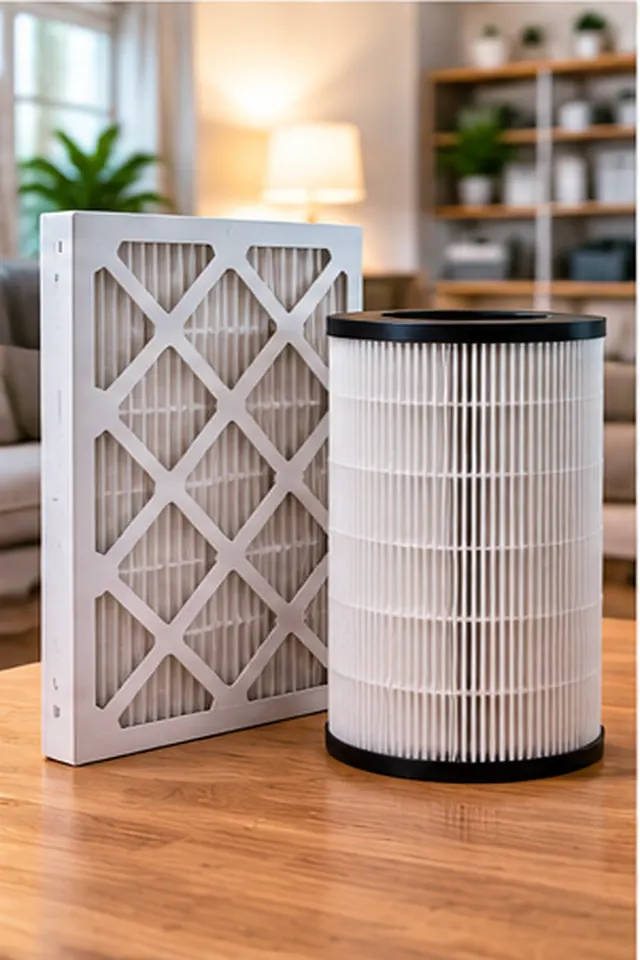
MERV and HEPA are not two versions of the same simple number. MERV rates the particle-capture performance of many HVAC filters using a graded system; HEPA identifies a high-efficiency filter class. The appliance that moves air through the filter also matters, as do pressure drop, fit and airflow bypass.
Where MERV is most relevant
The US EPA recommends MERV 13 or as high as the central HVAC system can accommodate. The phrase “as high as the system can accommodate” matters: a restrictive filter can affect airflow if the equipment is not designed for it. Follow the manufacturer or HVAC professional’s guidance rather than forcing a filter into an unsuitable slot.
Where HEPA is most relevant
Portable air purifiers commonly use high-efficiency filters, including HEPA media, but the complete product’s smoke CADR is a better comparison for how quickly it can reduce particles in a room. The filter claim alone does not reveal the volume of cleaned air delivered at the actual setting.
Neither removes every pollutant
Particle filters are not a general solution for carbon dioxide, humidity, or many gas-phase pollutants. Some products include activated carbon for certain odors or gases, but EPA notes there is no widely used standardized CADR-style performance rating for removal of gases by portable cleaners.
Avoid a false one-number conversion
There is no universal trustworthy “MERV 13 equals HEPA X%” shopping shortcut for entire systems. Compare the specified particle-size test, filter fit, airflow and whole-device rated performance instead.
The important difference: filter efficiency versus room performance
MERV ratings describe the particle-capture performance of filters tested under the applicable system. HEPA refers to a different high-efficiency filtration standard. Neither label, by itself, states how quickly a particular portable appliance will clean the air in your room.
| Shopping decision | Main number to check | Why it matters |
|---|---|---|
| Replacing a central HVAC filter | Compatible MERV rating | A filter must work with the system’s available airflow and pressure |
| Buying a portable air purifier | Certified smoke CADR | This measures particle-cleaning delivery from the complete appliance |
| Comparing portable HEPA devices | Smoke CADR, noise and filter costs | Similar media claims can accompany different airflow rates |
| Trying to control gases or odors | Relevant sorbent performance and source control | Particle capture does not establish gas-removal effectiveness |
Example: MERV 13 in a home furnace
Suppose a homeowner currently uses a MERV 8 furnace filter and wants improved filtration. A MERV 13 filter may capture a greater proportion of certain particle sizes, but simply buying the highest rating available is not enough.
The replacement must fit correctly, and the heating or cooling system must accommodate the filter’s resistance to airflow. Check the equipment specifications or consult a qualified HVAC professional where compatibility is uncertain.
The US EPA recommends MERV 13, or the highest rating the system can accommodate. This is a compatibility-based recommendation, not permission to force a restrictive filter into any system. EPA air cleaner guide.
Example: two portable devices advertised as HEPA
Imagine one purifier has a certified smoke CADR of 100 cfm and another has 200 cfm. Their filter marketing may sound similar, but the second has twice the tested clean-air delivery rate for smoke particles at the stated operating condition.
That does not mean it will always clean a real room twice as effectively: fan speed, placement, connected spaces and actual operation matter. It does explain why the complete-device CADR is more useful for room sizing than a HEPA claim alone.
Reading filter labels without guessing equivalence
US and Canadian stores may display MERV, 3M’s MPR or retailer-specific FPR ratings. These labels are not interchangeable standards. Use the manufacturer’s published cross-reference when comparing a specific filter, rather than assuming that one MPR or FPR number always equals one MERV number.
| Label | What to check |
|---|---|
| MERV | The standardized particle-efficiency rating and system compatibility |
| MPR | The manufacturer’s stated particle-size performance and any documented MERV comparison |
| FPR | The retailer’s rating explanation and actual product specifications |
| HEPA | The applicable HEPA test standard and the complete device’s airflow |
| Smoke CADR | The portable air cleaner’s tested particle-cleaning delivery |
EPA’s MERV table lists MERV 13 at at least 50% average capture efficiency for 0.3–1.0 micrometre particles under the applicable test conditions. EPA also describes HEPA media as capturing at least 99.97% of 0.3-micrometre particles. Those figures describe different classifications and should not be compared as though they were complete-appliance room-cleaning rates.
For a central forced-air system, check whether a higher-efficiency replacement is compatible with the blower, filter slot and recommended pressure drop. A deeper filter may offer advantages in some systems, but it is not automatically compatible with every furnace.
During smoke events, more fan operating time can provide additional filtration when the system is suitable. Follow the equipment instructions, including any concerns about humidity control during cooling.
Source: US EPA MERV ratings and US EPA home air cleaner guidance.
Related Wisnaro guides
Frequently asked questions
Can I replace a MERV 8 filter with MERV 13?
Possibly, but verify the HVAC system can handle the filter resistance and fit.
Does a HEPA label tell me the right room size?
No. Check rated smoke CADR for the complete purifier.